Welcome back to another deep dive into a phrase that stuck with me. Today’s phrase carries a profound meaning. Many of us believe that once we’ve gone wrong too many times, there’s no turning back—only more trouble ahead. But the person behind today’s words refused to accept that. And neither do I.
Before we begin, in case you missed last week’s edition or find this series interesting, here’s the link to the last phrase: https://daboisastrgledt.wordpress.com/2025/03/09/the-creator/
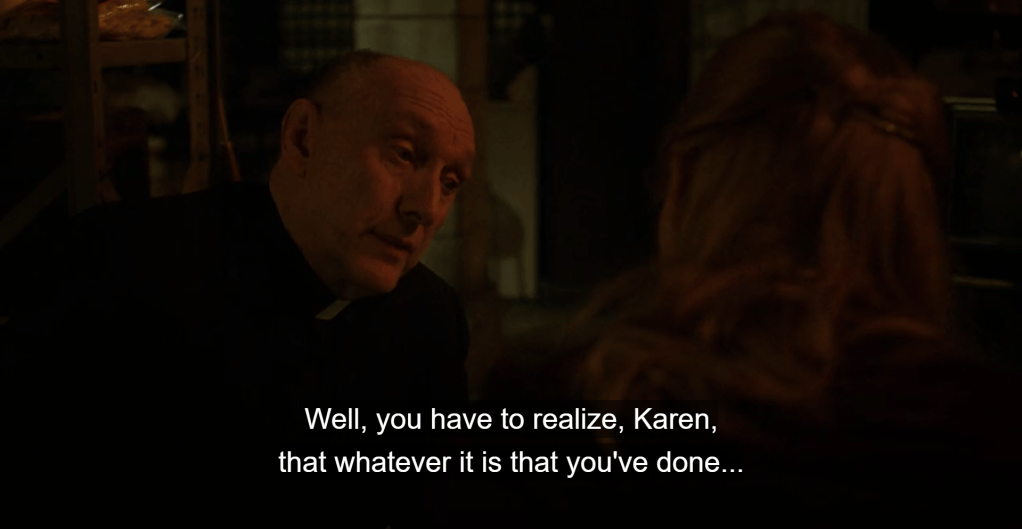
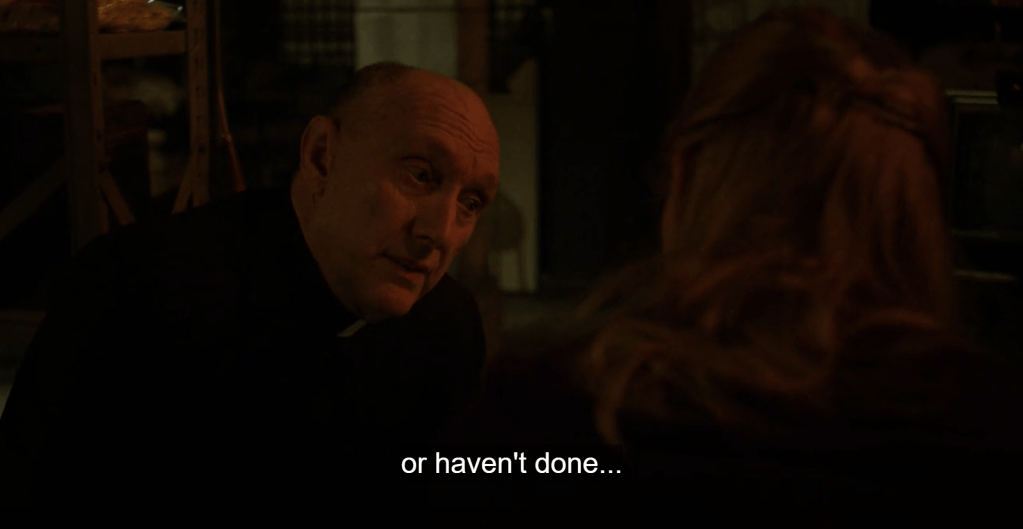
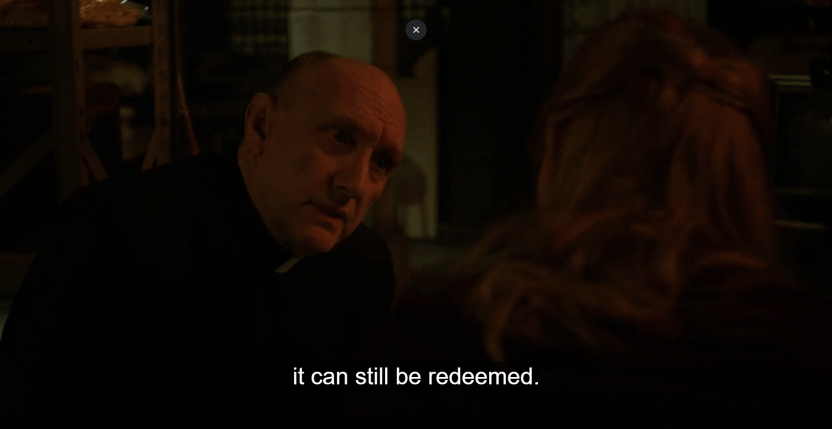
The words I’m focusing on today came from a priest. He said, “Well, you have to realize, Karen, that whatever it is that you’ve done… or haven’t done… it can still be redeemed.” This line comes from Father Lantom in Daredevil, Season 3, Episode 10, at exactly 33:06—yes, I was that focused—and his words hit right on the spot.
Father Lantom plays a crucial role in shaping the antagonist’s decisions and self-awareness. The series itself is fascinating and undoubtedly one of Marvel’s best. I won’t spoil anything from the show, but my suggestion? Give it a shot.
Since today’s topic connects directly to everyone’s life, I’ll explore how these words shaped my perspective—on what I’ve done, what I haven’t, and what I will try to do for as long as I breathe. As sugarcoated as that may sound.
What You’ve Done
What have you done? What have I done? How bad is the worst thing anyone has ever done? Maybe Father Lantom’s words don’t apply to people like Stalin, Chikatilo, or Jeffrey Dahmer—but they do apply to people like you and me. Unless, of course, you count yourself among that trio.
Yes, we’ve made plenty of mistakes—some that may have caused real harm to others (hopefully not literally), and some that might even be the worst things we’ve ever done. But how bad can a mistake truly be if neither your life nor the lives of those around you are permanently damaged?
I’ve written about many of my mistakes in my poetry, though I leave much to the reader’s imagination—letting them find themselves somewhere between the lines. Most people fail to fully grasp what I write—maybe because I write in code, or maybe because I write as I see it. But here, I’m not working with imagination. I’m working with facts—or at least, the closest thing to them that I have.
The truth is, that many of us fail to acknowledge our actions simply because we don’t admit them to ourselves in the first place. Why? Because facing the truth is hard. I know that from experience. My younger self—thankfully, that’s in the books—often struggled to look in the mirror and have an honest conversation about what I’d done, what I hadn’t, and what came next.
One of the biggest mistakes I made happened in the winter of 2019/2020, and it involved our German Shepherd, Rachel. My grandparents, growing older, could no longer care for her. I lived in a small apartment in the city, where a dog—especially one that size—wasn’t an option. And to be brutally honest, I wanted a dog, but I didn’t want the responsibility of taking care of one. Kind of like my idea of relationships.
So, when my grandparents told me they couldn’t keep Rachel anymore, I took it upon myself to find her a good home. That’s when I got a message from a woman in the Czech Republic. She claimed her son had always wanted a German Shepherd and that, the moment he saw Rachel’s picture, he cried. A touching story—just wait for the climax.
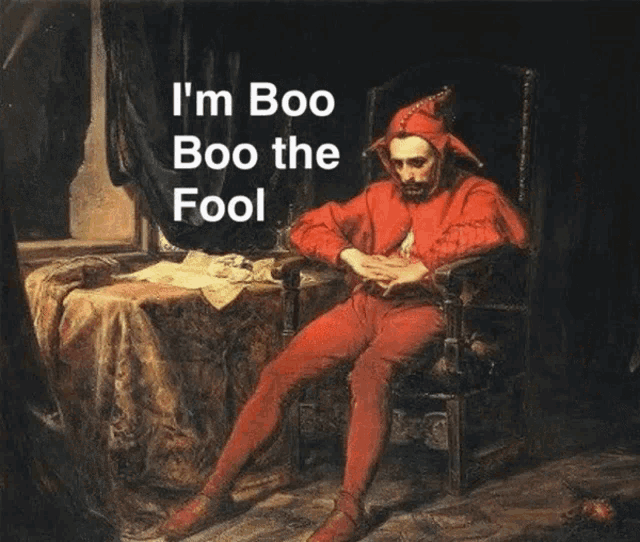
At first, I assumed they were Czechs living in Bulgaria, but it turned out they lived in the Czech Republic. To cut to the chase: I fell for an online scam.
I tried to speak with the woman on the phone. A couple of times, she called when I wasn’t around. Then I called, and she never picked up. Eventually, it seemed like texting was the best option. She offered to pay for everything and even tripled the amount I had listed for Rachel. That should have been my first red flag. But it wasn’t.
I wasn’t excited about parting with Rachel, but I was excited about the idea of sending her to a loving home—and, admittedly, about giving some money to my grandparents, but mostly excited about making some for myself. Of course, things didn’t go as planned.
The woman asked me to cover half of the transport fee upfront, supposedly as a guarantee. I paid—around 500 leva ($280). Looking back, who the hell buys a dog from 1,600 km (1,000 miles) away when they could easily find one closer? But at the time, I was too caught up in the idea that I was doing the right thing—blinded by the money.
And for years, I had laughed at elderly people who got scammed over the phone.
After the second payment, I expected confirmation from the shipping company. Instead, I got another email with yet another “unexpected” fee. By the time I realized what was happening, I had sent nearly 2,700 leva (~$1,500). Only then did I consult my parents. As you can imagine, they weren’t thrilled.
Still, I refused to believe I had been scammed. I mean, I wanted to be a computer engineer back then—how could I fall for something like this? But reality hit when yet another “final payment” request arrived, this time for 1,000 leva (~$560). My dad, knowing from the start it was a scam, refused to give me any more money. I begged. I cried. I convinced him. My mother withdrew the money and transferred it to me.
And, of course, the scam didn’t end there.
Next came the most absurd lie yet: the woman’s husband had supposedly been in a car accident while withdrawing money, leading to an FBI investigation that froze their funds. The FBI. In the Czech Republic. Over a dog sale. That’s when I knew—fully, undeniably—that it was a scam.
In the end, I lost a huge amount, never sold Rachel, never helped my grandparents, and certainly didn’t prove to anyone—especially myself—that I was the grown man I claimed to be.
At least there’s one silver lining: Rachel stayed with us. She’s still here, still wagging her tail, still doing fine.
And despite how long I blamed myself, the proof that I survived this mistake is right here—I’m still breathing, still capable of making bigger messes (as much as I try not to), but more importantly, still capable of learning and doing something meaningful. Hopefully.
What You Haven’t Done
What haven’t you done? What have you wanted to do but never did? What did you want to do yourself but couldn’t decide? Did I regret it? What about you?
“Well, you have to realize, Karen, that whatever it is that you’ve done… or haven’t done… it can still be redeemed.” Once again, Father Lantom’s words hit where it hurts. How many missed opportunities can you think of the moment someone asks you? I can list more than I care to admit—even the worst ones.
Here, we can count all the love that could’ve been but never was, the business ventures I never fully committed to, the unspoken apologies, the unacknowledged deeds. And this is where the difference between doing and not doing hits hardest. If what you did brings regret, the things left undone tend to linger longer, dampening the air with grief.
So yes, if you’re like me and have missed many chances in life, that shouldn’t stop you from missing future opportunities—take it from a pro. I mean, it will inevitably happen. One can’t do everything they want in life, but they should at least attempt the ones they fear they might regret skipping later. That’s probably been said by many, much smarter people than me. Because the truth is, what we haven’t done eats away at us just as much as what we have—unless, of course, you’ve killed someone. But then again, how would I know about that?
Excuse my silliness. So, why didn’t something happen? Because it wasn’t meant to be? Because we didn’t give it our all? Well, both are close to the truth, but it depends on what you believe—or what you intend to. My father—I mention him too much, but he always sounds profound—believes that if something didn’t happen, it was never meant to happen in the first place. I, on the other hand, believe that if something didn’t happen, it’s because we lacked the grit or failed to ride the wave long enough to see it through.
For every mistake I’ve made, there are hundreds more things I never did. And unfortunately, many of them could have been good. But even that’s not entirely true—because we often think something is right, only to realize, once we’ve done it, that the consequences tell a different story. I’m not trying to impose a grand philosophy here; I’m just saying that whatever you do—or don’t do—you will always reap the consequences. Every choice leads to regret because one thing is always sacrificed for another. A lot of people don’t believe that, but that’s just because they’ve only seen one side. Once they step over to the other, they’ll realize—or at least I hope they will—that wishful thinking always leads to disappointment, regardless of action or inaction.
I could tell you about the dozens of girls I never took the next step with—if you’re wondering, that includes second and third base—or the many more I never even spoke to because I figured it wasn’t worth my time (or theirs). Was I right? Was I wrong? Does it even matter? The unmade remains unmade. I’ve regretted some of those missed chances, but the ones that were worth it, I tried for. Maybe not in the best way—to say the least—but I tried, and I learned. So, I don’t regret it—oh, who am I fooling?
I’ve written poetry. I’ve deleted poetry. I’ve made lists, then thrown them away. I’ve sent messages; they’ve replied. I’ve written more; they’ve stopped replying. I was like a serial killer who wasn’t a serial killer—stalking but never crossing the line to be suspicious. Or maybe I did, and I just didn’t realize it. Anyway, I haven’t done much in love, and maybe that’s why I haven’t succeeded in it.
Let’s look at another type of situation: the people I’ve chosen to spend time with. More often than not, I surrounded myself with people who listened to me, or at least people I could impose my opinions on. I don’t mean to offend anyone, but the truth is, I almost always surrounded myself with people I thought were less perceptive than me. Not in terms of intelligence, but in how they saw the world—their perspective. Not that I’m some genius—quite the opposite—but I’ve had a certain emotional intelligence and understanding of things that I rarely noticed in those around me. And the few who did have it? They could be counted on one hand.
What didn’t I do with them? I wasn’t honest. And with many—actually, with all—I should have been. Do I wish I had been? Right now, no. But back then, when certain things happened, yes. Let’s be honest, there is no better feeling than being honest, but most people won’t understand honesty and would rather prefer lies, even if they hurt in the end.
Every single thing I’ve done—or haven’t—has brought me here. I am who I am because of it all. But couldn’t I have avoided a lot of the crap precisely because of the things I didn’t do?
I don’t know. And I have no idea. Maybe I shouldn’t have like my dad says. But I don’t buy that entirely.
I wanted to have a food truck in California, but I never did. I had saved up a chunk of money—about a third of what I needed for the project—and I had found a friend, a potential business partner. But in the end, it never happened. For a long time, I kept thinking about how to do it. I had ideas for the menu. I was vegan for two and a half years, and during the last year of that period, I had a solid business plan and a vision for making it work.
So what stopped me? First, my own insecurity. The seriousness I claimed to have wasn’t as real as I wanted it to be. My business partner was on the verge of bailing and flying back to his homeland—which never actually happened—but ultimately, I was the initiator, and I wasn’t ready for the idea I had pitched myself. Yes, I had experience managing a small team, but I had no experience running a business from top to bottom. I wanted to dive in without knowing how to swim. And after all, isn’t that the American dream?
But I’m not American. And, as it turns out, I wasn’t much of a dreamer either.
I had chosen the areas I wanted to work in, imagined the design of my truck, and planned the ad campaign. But all of it remained in my head, never reaching the execution phase—like most of the other things I’ve envisioned over the years.
I’ve had countless ideas, but very few have reached any kind of completion. And when I say completion, I don’t mean 50%—which is funny because I rarely even do half of that. Business ideas, creative projects, promises to myself and others—so much left unfinished.
I barely know what to do with myself, yet I’ve advised so many people. Shallow, isn’t it?
It Can Still Be Redeemed
And despite how stupid, wrong, or whatever else you might call it—it is—none of that matters. I’m the worst person in the world—according to some—or maybe not that bad, but still pretty bad, depending on which side of the fence you stand. Yet everything anyone has ever done—even me, even you—can be fixed. Let’s quote the great Jean-Jacques Rousseau: “Man is born free, and everywhere he is in chains.”
I don’t believe man is inherently good. He is born a devil. The angel within him fights to take control, but the struggle is hard and unfair. This view aligns with a biblical lens, even though I distance myself from belief in God. The Bible, in many ways, provides the blueprint for a stable society, yet too much leniency—too much “turning the other cheek”—has led to exploitation. The Quran, on the other hand, takes a firmer stance, emphasizing resilience and standing one’s ground, yet it lacks the same ethical universality. These are complex topics I may explore another time.
Still, something brought us here—whether pure chance or fate—and ever since man has existed, he has fought for dominance. To be liked, to be rich, to have control. And with these desires, he projects his thoughts and ambitions onto the world. Some have succeeded—Alexander the Great, Genghis Khan, Queen Victoria—but only for a time.
Some people are cruel, others pretend to be, but reality is far more nuanced. Through my own experience, I’ve come to see that unredeemed sin exists, yet I’ve also witnessed its counterexamples. I’ve tried to make amends for my misdeeds by helping others who have crossed my path. The unfortunate part is that nearly everyone who has stayed in my life for a while has, in some way, suffered for it. Is that good or bad? For them, mostly bad—because they spent time with a two-faced man. But if they know how to reflect, it could be a valuable lesson. For me, it’s certainly bad, as I lose people I’ve walked with for a time. Worse still, I’ve wasted both our time by presenting things that weren’t what I claimed them to be. Yet, even after so many mistakes, opening my eyes to what I should never do again is a gift in itself.
And despite my lies and betrayals, life keeps putting new faces in front of me—opportunities to correct past wrongs. Not to those in my past—they belong there—but to new people, allowing me to start fresh. That’s a gift I’m grateful for. The past doesn’t define the future; what does is how you feel about your past actions and what you choose to do next. The not-so-huge, yet super-huge Victor Hugo once said, “No man is so utterly ruined but that something yet remains in him to respond to kindness.”
Take the series Daredevil, which inspired today’s reflection. Matt Murdock, a lawyer by day and vigilante by night, has made mistakes—ones that have harmed and even cost lives. What should he do? Cut ties with those who oppose him, or find new ways to deal with them? In real life, both answers could be correct. But in the show, he continues fighting because, without that battle, he believes he is nothing. His fight and his desire to help others are his path to redemption. Only time will tell if he succeeds.
But what does his story teach us? Whatever you do, don’t regret your choices—own them. Jean-Paul Sartre said, “We are our choices.” You shouldn’t lie awake at night, tormented by what’s left unsaid. Like Matt, I’ve been on both sides of that battle. I never had my own Father Lantom, but I’ve met figures who offered guidance. And I can’t correct something I’m willing to repeat. If I chase every longing, I can’t right my past mistakes, because longing itself clouds the mind. It fuels emotions that demand action, and those actions often lead to consequences—most of them negative. And yet, we sometimes see people making mistake after mistake, only to be redeemed by a single defining act. It’s absurd. I can’t think of real-world examples, though I’m sure they exist.
Take Elon Musk. He once claimed a few billion dollars could fix Africa’s hunger crisis. He has far more than a few billion now, yet Africa’s problems remain. Of course, I’m not saying he should personally fix it—just that he made the claim. “With great power comes great responsibility,” as Voltaire supposedly said (though I just happen to see Uncle Ben). Later, Musk bought Twitter and turned it into X, and that promise faded into the background. Maybe it was just media noise, but I’ve seen the story reported in multiple places, including Reuters: https://www.reuters.com/markets/europe/un-official-still-hopes-musk-will-step-up-fight-world-hunger-2022-05-23/.
Musk stands at the top of the pyramid, yet his words linger unfulfilled. He never explicitly promised to solve world hunger, but if a few billion was all it took, why hasn’t it happened? Regardless, his statement remains. If you say something, follow through. If you don’t intend to, keep your mouth shut—an old Bulgarian saying. Musk still has time—and certainly the money—to make good on his words. But even if he doesn’t, he might still redeem himself through technological revolutions that benefit humanity. If that happens, do his past words still matter?
But let’s leave billionaires out of it. They have their problems, and we can’t hold them to every word they’ve ever spoken. Yes, Plato said, “The measure of a man is what he does with power,” and he was right—but good intentions are often mistaken. Those same public figures have been quoted in the media a thousand times. Now, imagine if our lives were under that kind of scrutiny. How many things have we said that could be twisted, misquoted, or used against us? How many promises have we broken? How many are we breaking even now?

Life is complicated—more than that, it’s unpredictable. Unless you’re Nostradamus… or Ray Dalio when it comes to markets. Even then, predicting the future is nearly impossible. And if someone makes enough predictions, some will be right. But does that make them a visionary? Maybe. But it doesn’t mean that making predictions—whether accurate or not—redeems one’s past mistakes or the things they’ve neglected.
What exactly needs to happen for me to know that I’ve redeemed myself? I have no way of knowing—and probably never will. Sometimes, you just get a feeling in the pit of your stomach, a moment of clarity that tells you you’re doing the right thing. And maybe, just maybe, that’s enough.
Sweet or Not, That’s the Final
I don’t know if I got off track a few times in the lines above, but thinking about the future, the past, and the consequences of both, even I got confused myself. I hope you found today’s message interesting and caught at least some of the tangents in what I said. Your perspective is important, but remember—the world goes on without it.
As I mentioned, I have done a lot, and even more, I have not. I will try in the future to shift the balance, to atone for past mistakes with the right thoughts and decisions, looking ahead while staying grounded in the present. The truth is never singular. It is told in different ways by different people throughout history. Nietzsche was one of them, and he put it simply: “There are no facts, only interpretations.” And no matter how much you or I believe in what’s right and truthful, there may always be another argument just as valid as ours.
If it were up to me, I would never make another mistake. But if that were possible, I suspect even avoiding mistakes could lead to unforeseen consequences. I have no way of knowing, but I also have no way of dismissing it—because it’s entirely possible. Not like believing in ghosts.
I keep moving forward, trying to get better with time. If I fail, then I haven’t truly tried. Empty talk is for empty people, and I think that version of Ivaniel is somewhere in the past—maybe. To be honest, he hasn’t left me completely and never will. But he’s learned his place. Fingers crossed.
Like a trained dog, I am here to help—not as I should, but as I can. Wouldn’t someone like that? Certainly. But if they don’t, what can I do? Well, as a famous Bulgarian football player once said, “Mmm… nothing.”
I won’t stop trying to be better. But if you ever meet me somewhere, sometime, and you think I’m failing or not trying—say it to my face. That’s how it should be. The same applies to everyone.
And you may not be a Karen, but whoever you are, remember these words:
“Well, you have to realize, that whatever it is that you’ve done… or haven’t done… it can still be redeemed.”
Thanks for reading!
Yours sincerely,
Ivaniel Georgiev


Leave a Reply