DABOISASTRGLEDT – by Ivaniel “Ivo” Georgiev
DABOIS, it’s time for another blog and I would say this one is as heavy as usual. Today I’m tackling a question I can’t stop but think about: why does history keep determining our lives when we’re trying to build something new, and why will that “something new” affect the future?
Before we continue, thank you. (YES, I WILL NOT STOP REPEATING IT!!!)

The time we have today will never come back, NEVER – it’s perhaps the only currency you never get refunded for, and you’re spending part of it here. That matters, and I’m sincerely glad.
If you’re new: this isn’t the usual corner of the internet where someone preaches or sells you something. This is a courtroom with no verdicts – only questions that lead to more questions, aimed at exposing what hasn’t been exposed (and reopen old cases, if needed).
I point out the things we accept, swallow, hide, and pretend don’t shape us – even though they control us. If something here makes you uncomfortable, good – discomfort is perhaps the best sign we have yet to realise.
- Curiosity lights the match.
- Action keeps the fire alive.
- Effort is what everyone talks about until it’s required.
I hope you stay until the end, but that’s up to you.
Today’s soundtrack: Erik Satie’s Gnossienne No. 1 – let it accompany you, or don’t. It won’t change what follows, but it might change how you feel it. (There’s an extended version if you’re interested.)
Now, let’s dive in.
Non-Contemporary: Why It’s Needed
At some point, each of us has found ourselves asking: Why is our life so strongly predetermined by history? (If you haven’t asked, now might be the perfect time.)
You can ignore the question, even mock it – depending on where you are in life and what your reality within yourself. But the answer? It doesn’t matter what you do or don’t do. What happened is already a fact. History can’t be erased – though plenty try. And even when they succeed in burying or rewriting some of it, the pressure initially created somehow still remains.
With that being said, the obsession with revolution means you’re always trying to erase something. Especially the parts that inconvenience whoever holds power at the moment. And yet people are not as forgetful as they’re made out to be. There are always those who, in one way or another, take notes – whether actual notes, books, entire volumes, habits, or even trauma passed down without language.
I’m not particularly interested in historical timelines or academic worship of the past. Everything that was once there, from the ancient empires to the Middle Ages, the modern era – they’re impressive, sure. But they’re not the point.
They all stacked up to deliver us to this Contemporary time: the so-called Postmodern Era.
And that makes my point simpler, yet more disturbing: we go through different eras, but human essence remains almost unchanged.
Swap all the physicality and the danger of past times for constant tension of not knowing if you’re on the right path in this free world – it doesn’t look so different after all. We can swap weapons for spreadsheets, plagues for algorithms, and gods for ideologies. It doesn’t matter if someone was born 20 centuries before Christ or 21 centuries after. The filth, the fear, the ambition, and the self-deception individuals live in remain remarkably familiar. And yes, there’s more comfort and convenience – like being born with an actual toilet – but so what?
At the core, things are the same.
That’s why the expression “Don’t listen to old people, but listen to those who have been through it” is as relevant as ever. It’s not about age and wisdom, but about how repetition teaches you where the wall is. The one who has made a mistake – even 100 times – and finally understood where it went wrong can point toward a more “gradually correct way”.
And yet, something inside me resists listening – no matter how insightful someone could be. Call it ego, laziness, stubborn hope, or something you and I haven’t figured out yet.
At the same time, I can’t escape the fact that I’m confronted with this “history” my ancestors left me – whether they did it with most gracious or worst intentions. But it’s not just ancestry; there’s a very big influence of pop culture, borrowed language, half-understood ideas that slip into my thinking when I’m not paying attention.
Old thoughts dressed in new clothes, pretending to be original.
But I agree with the following: what was contemporary for its time eventually reaches its peak form and becomes outdated – until it reaches a new peak in the more distant future.
So, what’s the difference, and why mention this process at all?
Although both are forms of time – one present, the other a mixture between past and future – there’s a particular difference. What has been experienced carries the breath of what we experience today as conditions. And yet, so many barriers exist between them that we overlook – obstacles that make the contemporary world different and, in fact, temporary.
In other words, the temporary period we’re going through will become an experience for future civilisations. Everything we’ve done – good or bad – will find its own way somewhere along the timeline of the non-contemporary.
Why? Right now, we live in a 24/7 working beach bar filled with distractions – all sorts of distractions – and if the bar is new, the scenery isn’t. There have been similar stories throughout history.
There’s also the fact that we think what we do is meaningless – and to me, this isn’t the whole truth. We can always leave a mark – starting with ourselves (I really hope we start there) – by living a more pleasant, more normal, more understandable life.
And so, whether we like it or not, we become one with the outdated while being completely modern creatures. We transform from “this” to “that” in a flick.
BOIS and GALS, what do you think? Does this Contemporary/Non-Contemporary dichotomy torment you too? One always pretends to be new, and the other just won’t accept staying buried.
Contemporary: How It Becomes Non-Contemporary
It’s a bit of a cliché to say that we all, in one way or another, breathe Julius Caesar’s molecules – but hey, ‘HEE‑HEE!’
And just like this, we arrived in the present.
Every day, people discuss human rights while violating what they preach. Someone goes on stage to express gratitude to the nation, regardless of the occasion.
Some ideas don’t just age – they mutate; they outgrow their creators, slip from context, and start acting on their own.
That brings me to two names: Marx and Nietzsche. People whose ideas were meant to resonate with society, and they did – but their climax was, well…
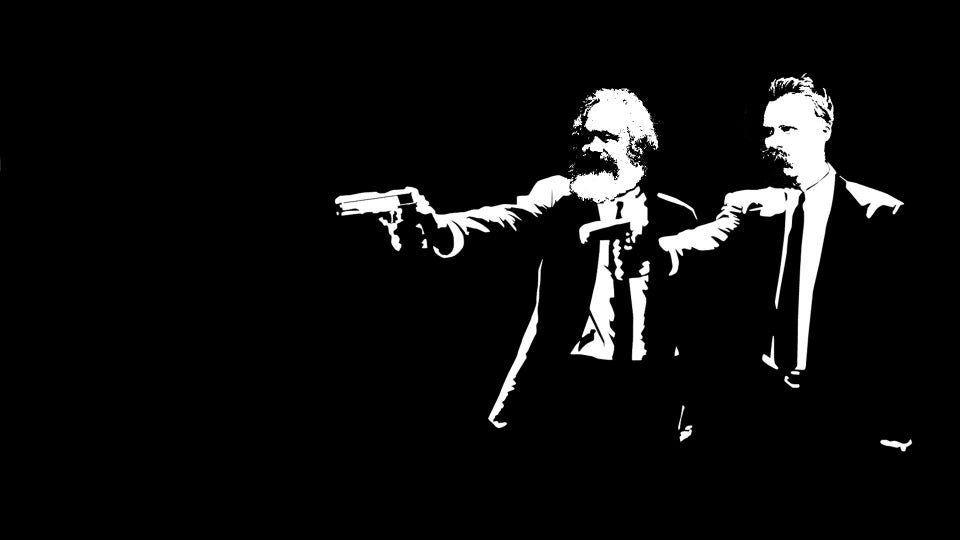
I’m mentioning them because I was recently introduced to their work, and I see how their ideas escaped containment and contributed as much to the world as they harmed it.
Karl Marx, a.k.a Harry Houdini
Marx predicted workers would realise they had “nothing to lose but their chains” and revolt. The revolution would create a global communist society where everyone would be equal, regardless of wealth or status. He called religion “the opium of the people” and argued communism was the natural form of human existence we’d return to once capitalism was eliminated. The “proletariat” would overthrow the self-destructive capitalist “bourgeoisie” and establish an international communist society.
My commentary:
His influence can’t be overstated. He gave workers language, leverage, and dignity that modern society quietly depends on – labour rights, unions, basic protections.
But Marx also believed history must resolve itself through conflict. That violence was not a tragedy, but a mechanism. He underestimated something fatal: psychological weakness.
Ideas don’t move through strong minds; they move through desperate ones.
And once power attached itself to Marx’s framework, nuance died quickly. Revolution became permission; suffering became collateral. The idea outlived the man – and no longer answered to him.
Did Marx intend this outcome? Probably not.
Did his ideas make it possible? Absolutely.
What Marx left is something we can’t do without: a living organism embedded in people’s minds; an idea that, when combined with power and other ideas wrapped around it, becomes something else entirely.
Friedrich Nietzsche, a.k.a Guns are Blazing.
If Marx built a system, Nietzsche lit a fuse.
Nietzsche believed in creating “one’s own meaning” in a meaningless world. He rejected objective truth in favour of subjective perspectivism, advocating for the self-transcending individual (Übermensch) who accepts suffering and chaos through the will to power rather than traditional morality or religion.
He proclaimed the “death of God” in The Gay Science: “God is dead. God remains dead. And we have killed him.” He wasn’t celebrating; he was warning. He understood that removing moral foundations without replacing them would not free people, but hollow them out.
Then his sister twisted everything. After his mental breakdown in 1889, Elisabeth Förster-Nietzsche edited his writings to align his philosophy with her fiercely anti-Semitic beliefs.
The Nazis selectively butchered his concepts:
- The “superman” (Übermensch) became a vision of a racially superior being – a “master race.”
- Thus Spoke Zarathustra presented the superman and “dangerous living,” popular among soldiers.
- Beyond Good and Evil contained ideas about “will to power” and criticism of conventional morality.
My commentary:
Nietzsche believed in self-overcoming, not domination. Individual creation, not obedience. But his language was sharp, poetic, and dangerously easy to misuse.
Ideas don’t care about intention; they care about who picks them up.
Even if he didn’t directly inspire Hitler’s plans for WWII, it doesn’t mean he’s off the hook. When the Nazis selectively butchered his work – helped along by his sister’s manipulations – his philosophy was stripped of restraint and repurposed into justification.
His ideas were descriptive of human nature. When you set out to do something, you should anticipate the effects – especially when you’re someone like Nietzsche.
But it happened. And if Nietzsche didn’t design the machine, he left a very easy and profound guide with instructions.
What’s important is how, after all this, the contemporary abruptly shifted to the non-contemporary, which continues to inspire people today.
What… The Actual Fuck
Really, what the hell?
Contemporary or not – what does it matter?
Whatever happened happened! And whatever will happen will!
We live in a world with strictly defined boundaries of irrelevance while striving to put the contemporary on the agenda and let it grow into irrelevance.
Life is lived anyway – from the past, from the present, from the future, from all generations. The world will end one day. Many have predicted it, and some will be right.
But again – what does it matter?
The Germans have given us so much – good and bad – and continue in the same vein. So many trends originated there after World War II. Freedom that turned into debauchery. Every period has such a phase where power and norms are lost in “nihilistic everyday life.”
But who can we blame? It can’t be solely the Germans, right? Maybe The US? The French? The British? Yes, I’m leaning toward Europe – because even the US is a European ideological project. Our continent has been spreading its contemporary ideas for centuries, trying to render them into non-contemporary ones. We’ve educated the rest of the world in one form or another.
And yet, many colonised cultures preserved themselves. Why? Because foreign ideology, even if oppressive, remains foreign.
Europe has gone through a lot – and here I exclude myself and my nation because, although we’re part of the continent, our historical path has been very different. It’s not that we haven’t had misfortunes, but what we as a nation have experienced has shaped us culturally, regionally, and personally in a very distinct and rather different way. So the Europe we idealise doesn’t always translate to the reality here.
We Bulgarians didn’t experience Europe the way Europe remembers itself. Five centuries under Ottoman rule didn’t erase identity, but it froze development in place while the rest of the continent industrialised, urbanised, and reorganised power.
Then, in 1878, we got liberated, and it didn’t change much. There’s always this pursuit of the non-contemporary while the contemporary in which my ancestors lived didn’t kill them by accident.
When independence came, it came fast – too fast.
The first constitution – the Tarnovo Constitution – created immediately after liberation, was so modern for its time, it’s unbelievable. But Bulgarians had a lot to catch up to. The problem? They tried to fix contemporary issues through non-contemporary means.
These were people under foreign rule for 500 years, who suddenly decided to leave the village and become citizens. But as history shows, this is a difficult process – still is.
When you try to skip stages, life – contemporary or not – doesn’t forgive.
This led to bloody revolutions, our communist model, our unclear departure from it, ending with what Bulgaria is today – slowly and gradually changing (but is it for good? I don’t know… time will tell).
Each phase promised modernity. Each left a residue.
So here we are: always catching up, always borrowing futures that don’t quite fit.
This isn’t uniquely Bulgarian. It’s just painfully visible here – cultures cannot leap over their own becoming, and when they try, something fractures.

This means only one thing: the dichotomy between Contemporary and Non-Contemporary won’t stop tearing humanity apart – some nations more, others less, but certainly all of them.
We live in a time obsessed with relevance while terrified of depth. Everything must be new, loud, urgent – nevertheless, instantly disposable.
The contemporary has a short half-life, and what survives becomes non-contemporary – not because it’s outdated, but because it endured.
And that’s the contradiction: we chase progress while pretending inheritance doesn’t matter.
It does – and every attempt to erase the past only ensures it returns unexamined.
So, here’s my poem for today:
Contemporary/Non-Contemporary
Beneath the window
they pass like molecules
– forever rushing, lost –
hundreds… thousands… faces.
Time grows old,
and somehow never ages —
information is a gift…
information is a maze.
The Contemporary – a garden.
The Contemporary – a blessing.
Contemporary and eternal…
the Contemporary – guile.
The Non-Contemporary – a king.
The Non-Contemporary – a painting.
Non-Contemporary and distinct…
the Non-Contemporary – fragile.
A constant, yet somehow
a distant, almost real interest;
a constant, yes, a strange one –
progressing, but progressless.
With the forever idea that
we will improve, we will progress;
that the awaited day will come –
a true Easter (period/ness).
But this burning thought
of universal good and eternal spell –
very different in every mind:
for some… progress; for others… a slum.
And so we mutually dispose
of this – faceless wealth:
one Contemporary… never enough;
the Non-Contemporary… always lunges.
The END¿
I don’t have much to say per my usual inspirational ending – no moral bow to tie here.
Contemporary will always exist and will be lived. Non-Contemporary will always be discussed while living. And both will continue shaping us – whether we admit it or not.
Even if AI takes us off the face of earth, they’ll continue our narrative – in their own twist (which, in non-contemporary meaning, is pretty much ours).
There will always be someone to tell your story, and in one form or another, it will serve as inspiration or a warning. And while you’re alive, you’ll always do the same – whether you like it or not.
Live accordingly.
C’est La Vie, and thank you for trying!
If you missed the last post, catch up @ You Must Be the Change You Wish to See in the World: or You Wouldn’t…
Subscribe to my Newsletter – sharp, thought-provoking, and high in fibre (plus a guide I swear by).
Sincerely yours,
Ivaniel “The-Contemporary-Non-Contemporarial-Silly-Goose” Georgiev


Leave a Reply