DABOISASTRGLEDT (phrases) – by Ivaniel “Ivo” Georgiev
DABOIS, I just finished another episode of Modern Wisdom, and I have the right phrase – well, a whole thread, to be honest. This one included the controversial Bonnie Blue in a three-way session (not what you think of), Louise Perry as the answer seeker and Chris Williamson as the arbiter. What started as a conversation about the burden of being a sex worker ended somewhere more interesting – as many conversations do when the participants are honest enough to follow the thread.
Somewhere in the first part, Louise Perry asked Bonnie Blue a simple question: “Do you think you’ll ever stop?”
“Possibly. But I don’t have a plan anymore. And for some people, that sounds really stressful. I used to have the most structured life. I knew exactly what I’d be doing on a Tuesday midday. Where I’d be getting lunch from. And now I don’t have a plan. Because sometimes when you have a plan, you become so fixated on the future – what one year looks like, what two years looks like, what five years down the line looks like. And then you dismiss everyday happiness. You forget to live your life in this moment and time.”
I’ve heard variations of this in philosophy lectures, meditation retreats, and self-help books. I’ve never heard it said more plainly – in a different context sure, by someone profound like Sun Tzu or the Dalai Lama or a Japanese poet in the Middle Ages, but here, it feels very contemporary.
Yet, that is not the complete truth; there is rarely any such thing. While this perspective works today, tomorrow brings a different setting. What follows, quite simply, is not a moral defense of what Bonnie Blue does. It’s something more uncomfortable and more human: an attempt to understand why someone who operates so far outside of conventional frameworks seems, at least to an outside observer, genuinely free – and what four of the most serious thinkers in Western history would make of that.
· · ·
Before we continue, thank you. (YES, I WILL NOT STOP REPEATING IT!)
I know time can’t be returned – NEVER – and I’m genuinely glad you’re spending part of it here.

If you’re new: this isn’t a place for preaching or selling. It’s a courtroom with no verdicts – only questions that open into more questions. My goal is to reveal what has not been revealed – or if it has been, to at least give a different point of view on it.
I point out the things that we accept, swallow, or hide and pretend daily that they don’t shape us – even though we’re under their control. If something here makes you feel uncomfortable, then you’re on the right path – discomfort is perhaps the best sign that we haven’t yet learned how to anesthetise it.
- Curiosity lights the match.
- Action keeps the fire alive.
- Effort is what everyone talks about until it becomes necessary.
Oh, I almost forgot today’s loop: “Virtual Insanity” by Jamiroquai – everything today lives in that frequency; whether you like the blog or not, if you haven’t heard this one tune, it will definitely become one of your favourites.
Let’s see now what creates a tension – in a most positive way – between Bonnie Blue and some of the greatest thinkers in history. (I hope you stay until the end… but that’s up to you.)
· · ·
The “BB“ phenomenon
Let me be straight with you before philosophising: I don’t endorse what Bonnie Blue does. I’m also not sure I have the standing to condemn it – consuming the thing you publicly disapprove of is one of the defining hypocrisies of our time, and I’m not exempt.
To me, she is a byproduct of this specific contemporary environment who managed to become a subject rather than an object inside it. On the contrary, I’m more of an object in society, but I’m also a byproduct of the same, but not quite the same contemporary environment – and I suck at playing the game.
Anyway, enough about me. Most of the people in her industry don’t get that choice. She took it anyway – and so far, she rides the wave by setting world records that most people are disgusted by, while secretly keeping score.
What strikes me isn’t her provocativeness but, more so, her coherence.
To me, she is a byproduct of this contemporary environment and the way she manages to exist in it, and she has successfully transitioned from object to subject – if one, of course, considers the latter a success. I, on the other hand, remain an object within society – shaped by a similar world, yet very incapable of playing the game.
Regardless, most individuals in her industry are never afforded a choice. Maybe she got in “at the right moment”; maybe she is different…maybe, maybe, maybe. What matters is, she claimed hers anyway. Now, she rides the wave, setting world records that provoke public disgust while she quietly keeps score. What strikes me is not her provocativeness, but her absolute coherence.”

In a culture running almost entirely on performance – think of performed confidence, performed opinions, performed identities, etc. – she operates like a smooth operator with a consistency that is either genuine self-possession or the most convincing simulation of it we may have encountered. At some point, the distinction stops mattering. Your life is your life, and everyone does harm – the question is always one of scale and visibility, and “what if you truly did bad?”
I notice that society hates visible appetite while secretly orbiting it. Bonnie Blue is a visible appetite, just made articulate. I must repeat that’s not a moral argument – it’s an observation about what makes her so disorienting and/or enigmatic to watch (when she’s having a discussion, obviously).
· · ·
Plato
I’ll start in chronological order with the thinkers I prepared for today, and the first one is not just anyone, but Plato. His central move was to argue that the material, sensory world is a shadow of something more real. Through the Theory of Forms, he described an eternal realm of perfect archetypes – the Good, the True, and the Beautiful. His protagonist, the philosopher, succeeded in turning away from illusion toward the light. The latter is referred to as “the Sun.” Why did he do it, and how did that affect him? He felt that therein lies what actually matters.
His Allegory of the Cave describes people chained underground, watching shadows on a wall and mistaking them for reality. Most never leave. The philosopher is the one who turns around.
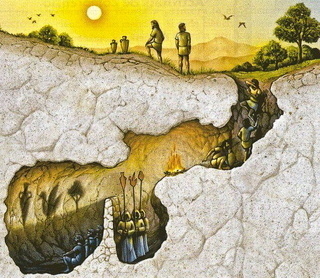
Bonnie Blue may not be a philosopher in the academic sense, but she has stopped watching the shadows – if ever paid attention to them in the first place. She refused the performance of a respectable life, the performance of shame, the performance of having a plan, and so on. Whether that refusal points toward anything higher is genuinely debatable. What it does is expose, by contrast, how many people around her are still chained to the wall and don’t know it.
Plato wouldn’t call her enlightened, but even disagreeing with her choices, he may acknowledge her path to the Monad. In a more platonic and present time sense, he’d call her troubling: someone who accidentally bypassed the cave by never agreeing to sit inside it.
· · ·
Dante
Next on the list is the father of the Italian language. In the 1300s, Dante made a choice that changed European literature: he wrote the Divine Comedy not in Latin – back then, considered the language of serious thought – but in the Florentine dialect spoken by ordinary people. That act of translation, of bringing the highest ideas down into living language, was itself a philosophical statement.
At the end of his ascent through Paradise, Dante arrives at a vision of absolute reality and names it with a single word: Love. This is not to be mistaken for sentiment – the unifying force that moves the sun and the other stars. The final line of the Comedy isn’t a theological formula but an ecstatic recognition. One, where everything is held together by something that can only be called love because no more precise word exists. (It’s as poetic as it gets.)

What connects this to Bonnie Blue is the passage I quoted at the opening. The rejection of the five-year plan. Thus, her insistence on present happiness over future security. “What’s going to make me happy now is not necessarily what’s going to make me happy in ten years.”
That’s a form of rebellion and a refusal to sacrifice the present for a distant, purely imagined future – which is closer to Dante’s vision than it first appears. The Comedy is, among other things, a story about what happens when you stop living in anticipation and start living in the thing itself.
I’m not saying she moves the sun and the stars. I’m saying she weaponises things such as intimacy, authenticity, and presence in a self-indulging culture starving for all three – and that has its own gravitational pull.
· · ·
Kant and Hegel
Kant’s central insight: the mind doesn’t passively receive reality – it organises it. Space, time, and causality aren’t mere features of the world; they’re the very structures the mind imposes on raw experience. Beyond what we can perceive lies the noumenon – the thing-in-itself – which reason can gesture toward but never reach.
His ethics followed the same logic: act only according to principles you could will to become universal law. Treat humanity, in yourself and others, as an end – never merely as a means.
Hegel’s response: the separation between mind and world is itself an illusion. Reality is Spirit – the very famous “Geist” – unfolding through history toward self-knowledge. Therefore, conflict isn’t failure, but the mechanism of development. (Thesis, antithesis, synthesis.)

Where do they connect to Bonnie Blue? Surely not in validation – Kant’s categorical imperative would have serious things to say about commodifying intimacy – but in the tension they illuminate. Both frameworks arrive at the same conclusion from different directions: reality is deeper than what we perform within it, and that performance eventually breaks down.
Bonnie Blue’s existence is, among other things, a point of breakdown. She makes visible what the performance is designed to conceal: that appetite exists, that judgment is envy in chic dress, that the line between transgression and freedom is drawn by whoever holds the authority to do so.
That’s not the same as being right; it’s the same as being a useful contradiction.
· · ·
The core connection – and the paradox within
Plato’s One. Kant’s noumenon. Dante’s Love. Hegel’s Geist.
Four different names for the same recurring human intuition: beneath the world we perform, there is something more real, and most of us spend our lives avoiding contact with it.
These thinkers all believed, in their different ways, that the surface of things is not the whole of things. That the most important realities are precisely the ones most difficult to face.
Bonnie Blue doesn’t embody their conclusions. She unintentionally exposes the tensions they spent centuries trying to articulate – the gap between performance and presence, between the life we plan and the life we actually live, and between the appetite we have and the one we permit ourselves to admit to.
But there’s a larger paradox here, and it’s the most honest thing in this piece from a less individualistic and more social perspective:
If the Monad is Love, then Love requires Trust. Trust requires Free Will. Free Will allows harm. The universe built on love rather than control is also the universe in which damage is not only possible but also waiting, which means radical authenticity and radical destruction are not opposites. (They are the same act viewed from different positions.)

That doesn’t resolve whether what Bonnie Blue does is good or bad – and she may be both depending on where you stand and what you are defending/against. My point is a simple suggestion that the question is less interesting than the one beneath it: What does it mean that her particular form of freedom is so visible, so disturbing, and so impossible to stop watching?
· · ·
The honest part
I admire what BB represents as a concept more than I could embody it as a person.
I’d like to believe I’m indifferent to approval, but then again, it’s always good when you get some – and when you get some, you eventually want more, and where does that exactly end? I’m also too aware of consequences to ignore them, yet I do everything that ends up with experiencing consequences. I’m too prone to shame, remorse, and the long internal conversation that follows most decisions – which is to say, I still go to a place she apparently skips.
I’m not sure that’s a weakness, but I’m certain it’s not a strength either. It might just be what it means to be somewhere and nowhere (referred to as “the middle”) at the same time: aware enough to see the performance but not free enough to step out of it completely.

What I take from her – and from the philosophers, and from the question(s) Perry asked that she answered so plainly – is something smaller, yet very practical: the five-year plan is not life itself; the Friday brunch spot is not the self; knowing what you’ll be doing on a specific date a couple of years from now is not the same as knowing who you are. (If we consider the last one is possible at all.) And I know I end up on a very positive cultural note, but honestly, pretty much that’s it.
That much, at least, is undeniable.
· · ·
Keep yourselves conscious, BOIS and GALS.
Try to live in the thing, not only in anticipation of it.
And if you figure out how, please let us know. (We are all in need.)
Sincerely yours,
Ivaniel “the-almost-accepting-and-looking-for-love” Georgiev
· · ·
p.s. In case you missed the post and you’re interested, you can check it out @ Rick Glassman’s “No Condom” Concept: A Contemporary Conversation with Historical Figures… (Oh, and don’t forget to subscribe to my daily newsletter for more interesting and fibre-rich content). Oh, one more “Oh” – I almost forgot today’s poem…
Li/oving
In the fires of this endless day,
I smoulder slowly in the darkness;
held hostage by my bodily decay –
half-ashamed, a silhouette disastrous.
Chasing after praise I never needed,
making endless promises, yet saved no one.
Action or the lack of – a fleabag fetid.
I didn’t burn away; now, the flame I trust.
Behind the cellophane, a soul awaits,
capable of living on bizarre, unruly terms;
it isn’t fire that kills, but fear being praised –
as if he’s my king, I kneel often and affirm.
Stalled in the middle ground – not lost,
I love strangely, in the only way I can;
I’m an abstract canvas, lost or locked –
the exhibit missing in the black museum.


One thought on “Plato, Dante, Kant, Hegel, and Bonnie Blue: the Material, the Physical, Accepting and Li/oving…”