DABOISASTRGLEDT – Ivaniel “Ivo” Georgiev
DABOIS, I started thinking about this one through music, then I watched a TV show, then I read a book, and eventually, I ended up.
You could ask why exactly music was first, but I think it’s pretty obvious: music is perhaps the only thing that gets past my defences before my brain has a chance to put any up. You might be washing up, minding your own business, feeling perfectly fine – then suddenly a song starts playing, and you feel nostalgic for no reason; maybe you start thinking about past mistakes or future endeavours… all while standing in a place you swore you’d forgotten.
And when a couple of those happen in some sort of order, you accidentally get an idea that is orbiting around all of them. Of course, this isn’t a metaphor (unless you want it to be). I see it as a distraction from what matters – but then again, I ask myself, “What is it really that matters?”
Anyway, we all don’t know anything for sure (even if we’re so sure we do), and we let things happen and mostly never realise something like a three-minute chord progression, a single line, or an awkward moment has more control over our nervous system.
In today’s blog, everything boils down to contradiction, so I propose we shall leave that for the end, where everyone will have the right to object as much as they like.
What I mean is this: life contains both suffering and joy (it’s a story as old as time), and as cliché as it is, they must both be accepted for what they are. And depending on what, how much, and how they arrive, we must navigate our thoughts, actions, and decisions. That much I believe isn’t as controversial as people may think. What’s controversial is the idea I want to build toward – that the wisdom we need most tends to arrive through the things we least expect to carry it.
· · ·
Before we continue, thank you. (YES, I WILL NOT STOP REPEATING IT!)

I know time cannot be reclaimed, and I’m genuinely glad you’re spending some of it here.
If you’re new: this isn’t a place for preaching or selling. It’s a courtroom with no verdicts – only questions that lead to further questions. My aim is to reveal what has not been revealed – or, if it has been, to at least offer a different perspective on it. (And, of course, to do something with what’s already been recognised.)
I highlight the things we accept, swallow, or hide and pretend every day that they do not shape us (even though we do not know what is truly happening). So, if something here makes you feel uncomfortable, then you’re on the right track: discomfort is perhaps the best sign that we haven’t yet learnt how to anesthetise it.
1. Curiosity lights the match.
2. Action keeps the fire alive.
3. Effort is what everyone talks about until it becomes necessary.
And, of course, right here is our checkpoint for today’s loop on DABOIS’s radio: ‘Cherish the Day’ by Sade – one of the many hits by the band. It has very much to do with today’s blog, but perhaps not in the way you could imagine.
Whether you’re tuned in or not, I hope you’ll stay until the end… but that’s up to you.
· · ·
The Theory
Here’s the core of today’s idea: everything is connected.
And that is not new. There are many conspiracies about the connection between all that exists. Of course, I stray away from manifestation ideas, so my point is leaning more towards the way that the universe doesn’t hand you a map – it is indeed a pile of coincidences – and you have to work out which ones matter.
Nobody gets the curriculum. Try it for yourself and learn – that’s the whole programme.
What connects the stars of today – Sade, Ted Lasso, and Andy Dwyer – isn’t obvious at all. However, it is rather interesting, and it deserves some of our attention: we encounter the very fragments of wisdom everywhere, but the meaning they acquire depends entirely on the person receiving them.
Which means that the same song strikes a cord differently at fifteen, twenty and so on – but that’s only one person, right? The same character lands differently depending on what you’ve been through. The connection isn’t hidden in the universe. It’s waiting for you to pay attention. I have the same theory for people who believe in karma. I don’t believe it’s the world that hits you back for being a jackshit of a person – it’s you who makes the mistakes and gets into trouble. Anyway, that’s not the point here, but I hope you get this little insight of mine.
· · ·
Sade Adu, a.k.a. The Smooth Operator Who Cherishes the Day
Hit after hit, decade after decade, and at first glance they’re all love songs – soft, understated, smooth, a little bit jazzy; overall, the kind of sound that is never in a hurry.
I read somewhere that she was very difficult to interview. It piqued my curiosity, so I dug into it. The claim was true, but I can’t agree with the context presented in the article. I doubt it was about ego or envy. If it was anything, it is quite the opposite: a defensive stance. Honestly, I see her as a person with a more conservative way of thinking, and I don’t mean politically – I mean boundary-setting.
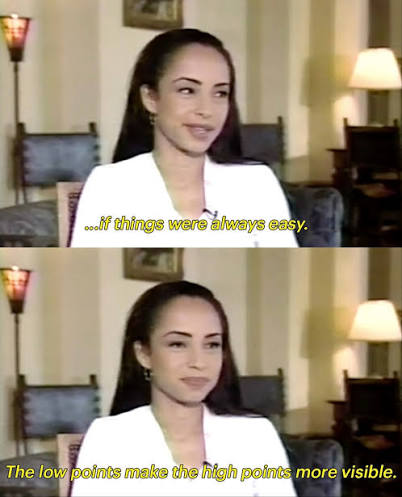
Which is somewhat strange when you look at her songs, because everything they represent is deeply personal. She built a peaceful life by fiercely protecting her privacy, stepping away from fame, and focusing on motherhood and her craft. Journalists over the decades describe her as self-assured and reserved rather than accommodating. But those who work closely with her – including the band members she insisted on signing alongside her from day one – frequently describe her as deeply grounded, loyal, and gracious.
I watched a short video of her talking about grief and music as therapy – “perhaps the best form of therapy”, in her own words. So, it seems, it’s not about grief so much as how you move through it and what you transform it into. And there’s rarely anything better than music, a good story, or an opportunity to laugh – which is kind of the whole concept for today.
Now, “Cherish the Day”. I didn’t choose this one because it’s her best song (at least to me, it isn’t). But I picked it because of what it does if you listen past the obvious – and its obvious title, which is kind of universal. We can immediately call it a love ballad, and we’d be technically right. But think about it outside that frame. She isn’t just speaking to someone… or perhaps that’s exactly what she’s doing.
“This is my prayer, cherish the day…”
She’s singing about a fleeting feeling. But the words work even without a person inside them. Think about what’s important to you. What keeps you going? Even someone who’s lost their way is guided by something.
Cherish the day. Full stop! (Don’t mind the exclamation mark.)
This isn’t exactly romance, is it? It’s an analogy for a simple yet present life. A philosophical framework about being inside something, fully, while you’re still inside it.
And whilst everyone loves the feeling the song brings them, very few notice the deeper truth – their truth. Sade herself probably doesn’t see the song the way I view it – and that’s perfectly normal. That’s the effect of interacting with art through your own experience. It’s not about what the artist intended. It’s about what the work becomes when it reaches you.
· · ·
Mr Proper, a.k.a. Ted Lasso
Here’s our second profile for discussion today, and it is indeed the G.O.A.T., Ted Lasso.
He is like the genie in the lamp who comes to the aid of those in need without anyone having to rub the lamp in the first place. He steps into a new role, faces a changing room full of men who are contractually obliged to show him basic patience, and somehow turns that minimum into something more. Few coaches can say they’ve truly become one with their players. Ted doesn’t just demand patience – he leaves people with no option but to start loving what he represents, sooner or later (and with him, it doesn’t take that long).
So I want to point out the following: this isn’t about some sort of tactics; you don’t need tactics if you can give someone something they’ve never had before. And he does this through a philosophy he actually lives by.
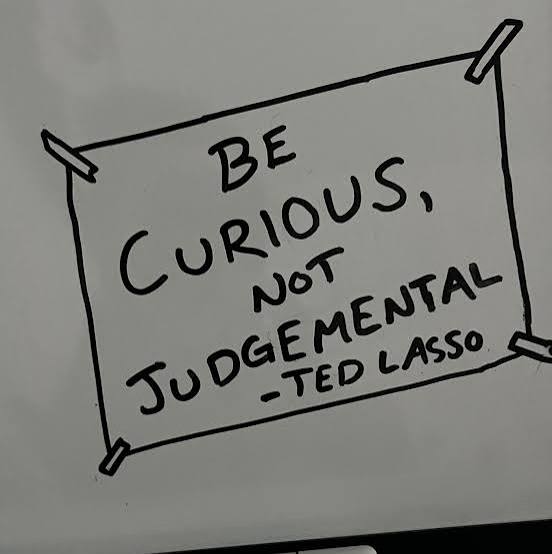
“Be curious, not judgemental” isn’t a poster on someone’s office wall – it’s his manifesto. And he hasn’t reached this through skill alone. The hardships he’s endured have given him something nothing else could.
He takes responsibility for every action without malicious intent – for the team, for the city, for his ex-wife’s opinion of him – and he’s found a way to carry all of it without becoming bitter or harsh.
And while people call him stupid, mostly because he is American – which is a stereotype for being stupid anywhere outside the US – he isn’t stupid at all.
I know many stupid people, and none of them will teach you more about life in less than ten seconds than his interaction with Sam (“You know what the happiest animal on earth is? It’s a goldfish. You know why? It’s got a 10-second memory. Be a goldfish, Sam.”
That isn’t stupidity at all – and if it is, then I consider myself stupid, looking out for inspiration in such words. I see a man disciplined in his kindness – and that is considerably harder than being simply clever.
Here’s a theory of his life philosophy, briefly:
- Be a goldfish, which means forget mistakes quickly and don’t let bad moments ruin the next move.
- Be curious, not judgemental, because that is the only way to recognise both good and bad patterns in people – especially the ones you struggle to understand.
- Success is more than winning. Why? Because helping people become the best versions of themselves matters more than what the scoreboard shows.
- Believe (for real). True hope and trust in each other can fix broken relationships and most of the problems one might have. It costs pain. It’s worth it.
If the hardest thing in the world isn’t just being clever or brave or honest – but all of those things simultaneously – then why do we look for these qualities separately? Because separating them creates order that’s easier to control. And isn’t that what each of us wants, in the end?
· · ·
Goofball, a.k.a. Andy Dwyer
Here’s our most wanted person №3, Andy Dwyer.
It’s interesting because Andy is kind of like Ted, but at the same time not at all – mostly because he doesn’t carry the same baggage as Ted Lasso. He grew up as one of seven boys in an incredibly chaotic home, and his early years were spent in constant brawls and games. His childlike, carefree, golden-retriever personality isn’t what could be described as a coping mechanism for trauma. The show presents it as a classic case of arrested development – much like the show that carries that name, where you grow up in an environment where nobody expects anything of you, and that leads to what we might call delayed maturation, where the adolescent’s conception of life is more entertainment than anything else.
Andy isn’t the main character in Parks and Recreation. He isn’t in charge of anything; he barely keeps his job, and yet he is one of the most memorable people in the show. Nobody relies on Andy for anything – and that gives him the freedom to be himself at any moment, anytime.

People point to his silliness as a flaw, but hidden within it, I see a form of audacity: the audacity of someone who never learned to pretend modesty in order to please others. He sings the theme song of a job he no longer has. He has absolutely no filter and is exactly as much Andy as only Andy can be. Where Ted has to filter himself through his role, Andy has never had a role big enough to require filtering.
I recently finished Steinbeck’s Of Mice and Men and pictured Andy throughout. Lennie – large, gentle, completely without malice – shares something essential with Andy across nearly a century. Neither of them has a mean bone. Which also means both could do the worst thing without realising it. The similarities in character aren’t enormous, but the observation struck me as worth naming.
Similar to Coach Ted’s life philosophy, here is Andy’s:
- Live in this moment (make every second count). He literally doesn’t worry about the future or dwell on the past – and this shouldn’t be mistaken for a strategy or a plan, because it is his natural state.
- Choosing joy over logic (literally no other choice for him). He is the kind of person who picks happiness and enthusiasm over what common sense or societal expectations usually demand.
- Accept everyone (for who they are). He judges no one and loves without established rules or conditions.
- Treat life as a game (as simple as that). He approaches things such as work, marriage, and adulthood as play. And somehow, because he is genuinely kind, he gets away with it in a way that a lesser person couldn’t.
· · ·
The Dots We Struggle to Connect
When it comes to Ted and Andy, neither type is “better”. This is probably the part most people overlook. Ted’s discipline comes at a cost in every single episode. Andy’s freedom is genuine precisely because it costs him nothing he values. We as observers can never fully have both – it always comes down to choosing our own tax bracket. And then there are Sade’s hits, which represent more than they seem to.
Three completely unrelated cultural artefacts, separated by decades, none of them speaking to the others – and all saying, in one way or another, the same thing:
Sade tells you to cherish the day.
Ted Lasso tells you that curiosity about people beats judgement.
Andy Dwyer reminds you that joy needs no permission or title.
Of course, there are other examples that I haven’t mentioned that can work as well or even better for you – but again, that’s up to you, the content you consume and the way you navigate the information from it. None of the three examples I described today is perfect, and they shouldn’t be. None of them has to become a model you blindly copy. And perhaps that’s precisely the point.
We spend so much of our lives searching for the person we’re supposed to become that we forget to notice the people, songs, stories, and moments already teaching us something about who we could be.
I didn’t connect these dots. Someone else wrote the song. Someone else chose the actor. Someone else lived the life that became the character. I simply observe – and I hope to apply more of what I observe, because it seems to me of fundamental importance if I want to live some version of an ordinary, righteous life.
And yes, everything circles back to the Stranger and his expanding interpretations. So how does anyone recreate their own version of that radiant kindness that asks for nothing in return? How is it that, despite these examples, we still fail to come any closer to them? These aren’t questions I’m answering today. These are questions I’m leaving where they belong – open because I don’t have the right answers.
Do whatever keeps the spark within you burning as brightly as only you can.
· · ·
BOIS and GALS, don’t just cherish the day. Pay attention to the things that change your mood, and acknowledge why you should cherish it.

Sincerely yours,
Ivaniel “The Struggling” Georgiev


One thought on “Cherish The Day: Or How Sade Adu, Ted Lasso and Andy Dwyer Said Everything That Needs to Be Said…”