DABOISASTRGLEDT – Ivaniel “Ivo” Georgiev
DABOIS, today I want to talk about sacrifice and how sacrifice can turn into love – and how love can turn into everything else that one needs. That’s the destination. What follows is how I got there.
Yesterday marked half a year since my grandfather’s death. And somehow, instead of feeling sad, I’m filled with something I can only call a “pleasant feeling” – the kind that comes from knowing he would have wanted me to become as good as possible with each passing day. He was the kind of person who was always happy to have guests over, who treated anyone who walked through his door as if they were already home. A giver, in the truest sense. He’s absent now. But I carry a part of him, and that part illuminates something about what this essay is actually about: what remains of someone after they are gone, and how love survives physical absence through action, memory, loyalty, and repetition.
His memory also asks something of me. It asks me to sacrifice something – probably the easy version of myself. The cynic who keeps the door closed. The one who waits one more day.
And if you’re a fan of ancient Greek poetry, you will love this one because I found the proof in Homer.
· · ·
Before we continue, thank you. (YES, I WILL NOT STOP REPEATING IT!)

I know time can’t be restored, and I’m genuinely glad you’re spending some of it here.
If you’re new: this isn’t a place for preaching or selling; it’s a courtroom with no verdicts – only questions that lead to further questions. My aim is to reveal what has not been revealed – or, if it has been, to at least offer a different perspective on it. (And, of course, to do something with what’s already been recognised.)
I highlight the things we accept, swallow, or hide and pretend every day that they do not shape us (even though we do not know what is truly happening). So, if something here makes you feel uncomfortable, then you’re on the right track: discomfort is perhaps the best sign that we haven’t yet learnt how to anesthetise it.
1. Curiosity lights the match.
2. Action keeps the fire alive.
3. Effort is what everyone talks about until it becomes necessary.
Today’s loop on DABOIS’s radio is how I feel exactly about today’s topic: ‘When Love Takes Over’ by David Guetta and Kelly Rowland. Music is an ambiguous thing, but like anything in life, if you interact with it with genuine intention, you’ll be set free. However, we can’t rely solely on music to save us; therefore, take into account what will be said in today’s blog.
Whether you’re tuned in or not, I hope you’ll stay until the end (but that’s up to you).
· · ·
What Homer’s Poems Actually Understood
Assuming he was a real person, biographical legends describe Homer as a rhapsode – a travelling bard whose livelihood depended entirely on the infrastructure of the polis. He observed the city from beyond its walls, spent time within them, travelled between many, and presumably realised that everything that exists today will one day burn. And yet he recited his epics, which suggest that burning can be overcome – or at least brought under control in time.
The gods in the Iliad don’t embody supreme moral justice. They argue with one another like a reality TV show, display biases, and treat human lives as pawns for entertainment. The poem shatters romantic notions of glory by revealing how futile and brutal war is and how it ends in deep sorrow rather than triumph. The Odyssey is built upon nostos (return home) and the decades-long loyalty between Odysseus and Penelope. At the end, even enemies are treated with dignity and respect.

Here’s the thing about cynicism, and why Homer matters to me specifically: a cynic believes people are entirely selfish and that values like honour, love, and self-sacrifice are false facades. Homer certainly didn’t hide humanity’s dark side. But his poems are not cynical. What they argue (very subtly, over thousands of lines) is something optimistic, yet very dark: that human beings can be violent, vain, selfish, proud, and destructive, and still be capable of recognising one another. That’s the astonishing thing. Not that people are secretly wonderful. That they sometimes choose humanity anyway.
I came to Homer indirectly, reluctantly, somewhat convinced this wouldn’t apply to me. Except I’m interested in any story involving morality, pain, and redemption – so apparently I was interested all along. (I shall thank my brain for storing my cookies so well.)
What I wasn’t prepared for was realising that Homer’s poems aren’t solely for ancient Greece. They address a specific, recurring, uncomfortable human problem: the state a person finds themselves in when they know what the right thing to do is, yet it takes them a long time to actually do it. The kind of love that interests me most – not the kind that arrives pure and remains pure, but the kind that comes late or in a bad moment and is worth more than anything precisely because of that.
· · ·
Heroes ≠ Role Models
Achilles is the greatest warrior in the Greek world, and he spends the first two-thirds of the Iliad grumbling in his tent because someone put him in a position he didn’t ask for. Odysseus is perhaps the smartest man in the room – and it still took him twenty years and the death of every single one of his men to make it home. Hector is the most honourable man in the poem, and honourable people make disastrous decisions – his tactical choice leads directly to his own death and hastens the downfall of everything he was trying to protect.
None of these characters is a role model in the contemporary sense. But here’s what strikes me: each of them, in the end and after paying the ultimate price, does the right thing (even if it’s too late). And each sacrifice is specific. Achilles sacrifices pride. Priam sacrifices dignity by kneeling before the man who killed his son. Odysseus sacrifices immortality. Penelope sacrifices certainty and two decades of her life. Sacrifice is always the thing that costs them most. That’s how you know it’s real.
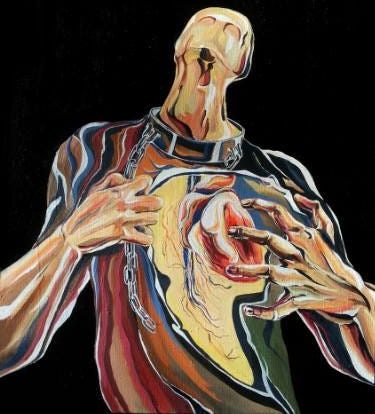
Achilles, after letting Patroclus die and allowing his pride to take precedence over everything, returns and fights with such all-encompassing grief it could be mistaken for rage. The rage arises after the grief – that detail matters. He defeats his enemy, then humiliates his body. But then comes the turning point: Priam, the king of Troy, enters the Greek camp alone at night, falls to Achilles’ knees, kisses his hand, and begs for the body of his son to bury him according to their tradition. And as destructive a force as Achilles is, he sits down and listens. He even weeps with him. He allows him to take his son’s body home – and only then is he free of the burden that his friend’s death set upon him.
Those are two men from opposing sides of a war that has destroyed everything, sitting together in the darkness, weeping for what they have lost, acknowledging one another as human beings. It happens far too late. Hector is dead. Patroclus is dead. Troy will burn anyway. And yet it happens.
The lesson is one of redemption and the burden it lifts: it is never too late for the gesture that proves you have been paying attention, even if you lost the plot somewhere along the way. Only when you truly realise something do you have no objection to what comes next, because you have experienced genuine feeling, even if the people with whom you would have liked to experience it are no longer among the living.
· · ·
Love as Mantra
We use the word ‘love’ to describe feelings that have nothing to do with it. The love that secretly permeates Homer’s epics is not an ordinary feeling, nor is it reserved for certain people. If I were to describe it, I would say it is much more like a ritual you practise: a recurring, costly, and often too-late decision to stand up for something greater than your own survival. Love becomes visible when it competes with self-interest. If love costs nothing, it’s often just preference.
Achilles loves Patroclus. This is never stated explicitly – it is demonstrated through the complete structural collapse of Achilles’s world when Patroclus dies. The Iliad technically tells the story of Achilles’s wrath, but what the wrath is really about is love that did not act in time. Love so certain the other person will be all right that it waits one more day – and that day costs everything.
Odysseus loves Penelope in his own way – the long, patient, desperate love of a man gone for twenty years. He refuses immortality. Calypso offers him eternal life, and he says no: he wants to go home. The concrete, irreplaceable, mortal thing is worth far more than the perfect, eternal, and accessible.
Penelope herself is the one Homer doesn’t talk about enough – and perhaps the one who deserves it most. She waits. She resists. She weaves and unweaves for years, keeping the space open, refusing to let her story end before Odysseus returns. This is her most difficult form of love: keeping alive the possibility of the return of someone who has not yet earned it. Whether that constitutes devotion or a different kind of loss, Homer doesn’t answer. Neither will I.

All of us, at various points, find ourselves in one of these positions. We are Achilles in his tent, defending his pride when we should be joining the battle. We are Odysseus, technically returning home but finding every possible detour. We are Hector on the wall, knowing it won’t be enough, going out anyway. We are Penelope, keeping the door open for someone who may not deserve it – because love is sometimes less about the other person than about what you refuse to stop being.
The problem is we often do it with the wrong intention and for the wrong reasons, and we realise too late. Late is better than never – but realising doesn’t mean anything if you don’t own what you realised.
· · ·
Ted, Sade, Andy… Again
Lately, when I have to make a decision, Ted Lasso’s face appears in my head. He’s the kind of person who believes in someone everyone else has written off. He finds what I’ll call “the right places” within everyone he meets – those motivations and beliefs that lie deep within people and that they themselves can’t deny – and treats them with particular care, the way only someone who can afford to love does.
Andy Dwyer crosses my mind too – the person who gives himself entirely to the moment, without that protective layer of irony the rest of us use so we won’t be caught showing we care.
And Sade, whom I listen to every single day, reminds me to cherish what’s in front of me – not because my life is particularly important, but because there are so many people like me who need to hear the right word or be treated with the right action. Her work doesn’t just portray love. It is love beyond love – patience, impartiality, sincerity, and asking nothing in return.
The same forces, different messages. One conclusion, woven into different narratives across different centuries. The Homeric language of love is not “I love you.” It is “I’ve returned” or “I’ve been here all along.” Love lives in an open yet inconspicuous space where the alternative (to cease being human) is not only more accessible but also temptingly easy.
· · ·
The Heroic Act Is Seldom the Dramatic One
What Homer’s poems understood – and what we keep needing to relearn – is that the heroic act is rarely the dramatic one. It is not found in the moments on the battlefield, though without those moments, reaching it would be nearly impossible. My point is, it comes long after, in the quiet decision to look pain straight in the eye and accept it. Sometimes, if you’re able to grasp it, that becomes love – and love can lead to places and a state of mind no one ever thought possible.
The epic is long because love is long. The epic repeats itself – clichéd epithets, recurring scenes, and the same phrases over and over – because love consists of repetition. The recipe: keep showing up day after day, keep saying the same things without being pushy, and keep doing what needs to be done. (Still, you have to remember that nothing happens without a slight push.)
Homer’s heroes don’t transcend the human condition. They are crushed by it, shaped by it, nearly destroyed by it. And yet they do the right thing.
It’s never too late for the gesture that proves you’ve been paying attention.
The world burns constantly anyway. So why not sit down like Achilles and Priam and shed a few tears, or speak the words we keep locked away – for the sake of something greater than ourselves? Even at the heart of disaster, at the heart of failure, amid the ruins of every decision that led you here, humanity is not only possible through love. It is necessary.
Homer’s poems knew that most of us probably wouldn’t do it. And I think that’s precisely why they bequeathed to us what they did – which is also a form of love (of the purest kind).
Troy falls. That was never in doubt. What matters is what remains human while it does.
So, BOIS and GALS, love doesn’t prevent loss. But loss doesn’t invalidate love. The world is burning. That has always been true. And yet here we are, on our way to…
Sincerely,
Ivaniel “Learning to Love” Georgiev
In case you missed the last blog, you can check it out @ Generational Rhetoric, Misdirection, and the Importance of Sincerity…
Oh, and if you find the information here useful, you can subscribe to my newsletter as well (sharp, thought-provoking, and high in fibre).


One thought on “Homer Knew, So Why Don’t You and I Try Too…”