DABOISASTRGLEDT (phrases) – Ivaniel “Ivo” Georgiev
DABOIS, as of yesterday I’m officially 26 – which means one step closer to the cemetery, or the crematorium… or whichever comes first.
But jokes aside, this one matters to me more than most. It arose from reflections on three emotional forces (love, neediness, and envy) that I’ve been circling for a while without ever quite naming together. I rarely keep notes when it comes to “bad emotional forces” because they’re really not worth my time. However, that is not exactly true. And because love is tangled in this mess, I can’t help but point out the realisations I arrived at. Yes, I’ve touched each of them in some ways in previous posts, but today I want to follow them to the end of the argument. Which is way messier than I’d like it to be (but I’d do my best).
The entry point was a Facebook post – a quote from a film called The Devil All the Time, which I’d seen a while ago but hadn’t fully retained. Worth watching again (you should too). The words come from Reverend Preston Teagardin:
“Envy. Brings out the worst in people. Especially the young ones.”
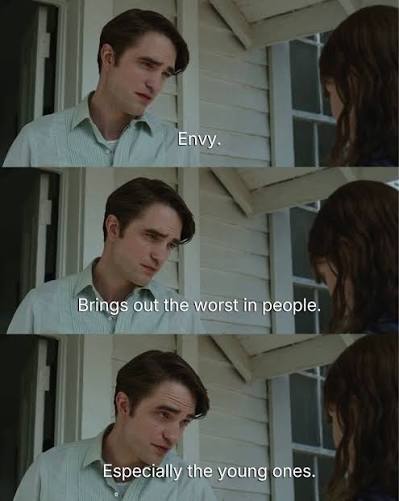
The words are as chilling as the man who says them. Teagardin is a predator who speaks the language of virtue while being consumed by the exact forces he names. He talks about envy from a place of envy. He preaches about morality while violating it. He is the shadow of today’s essay: a man who claimed to understand these forces and used that understanding as a weapon.
And while I’m not Teagardin, I’ve spent enough time this past week watching myself claim one thing and do another that the quote landed differently than I expected.
To have an idea of what I prepared for you today, I will give you the arc:
- Need is neutral – it becomes neediness when the need starts controlling the person.
- Envy is neediness turned outward at someone else’s life.
- Love is what happens when you give without needing to possess.
- And freedom – the very freedom hidden in the title – means that once you fire your emotional bullets, you don’t control where they land or what comes back.
So, please, set aside any preconceptions. Save your conclusions for the end. Everything here is observation rather than a prescription – and I’m the first piece of evidence.
· · ·
Before we continue, thank you. (YES, I WILL NOT STOP REPEATING IT!)

I know time cannot be reclaimed, and I’m genuinely glad you’re spending some of it here.
If you’re new: this isn’t a place for preaching or selling. It’s a courtroom with no verdicts – only questions that lead to further questions. My aim is to reveal what has not been revealed – or, if it has been, to at least offer a different perspective on it. (And, of course, to do something with what’s already been recognised.)
I highlight the things we accept, swallow, or hide and pretend every day that they do not shape us (even though we do not know what is truly happening). So, if something here makes you feel uncomfortable, then you’re on the right track: discomfort is perhaps the best sign that we haven’t yet learned how to anesthetise it.
1. Curiosity lights the match.
2. Action keeps the fire alive.
3. Effort is what everyone talks about until it becomes necessary.
And, of course, right here is our checkpoint for today’s loop on DABOIS’s radio: ‘So Much Trouble In The World’ by Bob Marley & The Wailers – one of the many hits by the band. There’s so much trouble in the world indeed. And we shall not add to it. Rather, we should use love to overcome what is in front of us.
Whether you’re tuned in or not, I hope you’ll stay until the end… but that’s up to you.
· · ·
Neediness
Everyone needs something. Most of us need many things. And the more things we are in need of, therefore using, the more we’re required to keep up with a growing appetite.
Need itself isn’t the problem. There’s something genuinely beautiful in unfulfilled need – a freedom, because what a person with an unmet need can imagine is essentially infinite. Need is what drives people toward things they haven’t yet discovered. (That’s not nothing.)
Neediness is what happens when the need starts running the person instead of the other way around. When satisfying it becomes less about what you actually want and more about plugging the holes – the present ones and the ones from years ago you’ve never quite addressed (which leads to future ones you’re not sure why you’re trying to fulfil).
I understand clearly that need is important – especially when you’re young. The longer you delay confronting the pattern underneath a need, the harder the confrontation becomes. I wish this weren’t true, but I’ve seen enough to stop lying to myself about it.
The entire process of liberation, it seems to me, looks like this: experience, lose, need, connect (again and again…) while observing what’s actually happening rather than the story you’re telling yourself about it. So, it’s something like “participation plus awareness”. Without the second part, the first is in contractionary loop.
Which brings me to the confession I have to make if I’m going to really write about this.

I consider myself someone who doesn’t need other people – or at least, someone who has trained himself to believe that. And yet, very recently, I found myself in a situation where I can admit with some difficulty that I apparently do need attention – not just any attention, but a specific kind, from a specific person. I spent several conversations explicitly denying this to the woman at the centre of it. It turned out I was trying to fit into her life without having been invited in and doing it in ways I’m not proud of.
So: even the person who claims to need nothing ultimately needs the very thing they’re running from. The story, of course, doesn’t end there – there’s always room for redemption, as long as certain lines aren’t crossed again. Whether they would be, time will tell. (I’ll do my best 🤟.)
· · ·
Envy
If neediness is dangerous, envy is neediness turned outward – neediness that has found a target.
It says something that sounds like, “You have something I lack, and that fact is intolerable.”
Teagardin is right that envy brings out the worst, especially in the young. He ought to know – his own envy of what others have (reputation, access, the appearance of virtue) is precisely what drives him to do what he does. The person who names a force most confidently is often the one most controlled by it. (That one’s worth remembering as well.)
Envy rarely announces itself as envy. It comes disguised – in the form of concern, as advice, perhaps as gossip. Rumours are interesting because they are one of its most common vehicles. A rumour doesn’t really need to be true to survive. It only needs to contain something believable. Envy needs a story, and a story needs something real to attach itself to – which is why a rumour about a person tends to carry a grain of their actual quality, even when the specific claim is invented. It’s important to remember that doesn’t mean the rumour is true; it rather means that envy is a craftsmanship.
I’ve been involved in conversations recently that pulled me toward exactly this kind of dynamic – talking about people in their absence, passing judgement on things I only partially understood. I used to do this more readily when I was younger. I told myself I’d moved past it. And this time, it turned out to be true. But I still participate and overhear things – which isn’t really up to me, and I’m not sure how I feel about this. That said, this week showed me I hadn’t moved as far as I thought.

Honestly, I don’t think anyone wants to be envious. No one is born as envious as they become when they first recognise it in themselves. It develops, fed by specific conditions – usually a combination of genuine lack and the inability to separate what someone else has from what you’re missing. Breaking free from it is difficult, like the amputation of a habit that’s been growing since childhood: the longer it’s left alone, the more established it becomes.
I’ve reduced my own envy significantly – redirected it more than eliminated it. I can’t claim it’s entirely gone – any claim that states “forever” would be a lie. What I can say is that I understand its root well enough to catch it earlier than I used to. Earlier is not the same as before the damage. But that kind of realisation is helping me to stray away from the damage that comes with envy.
· · ·
Love
I believe love is a cure. But love isn’t really a cure. It’s better to describe it as a different way of relating to what hurts.
The idea of love is pleasant – but at the same time can be self-destructive. I was about to cross that line (and perhaps I did to a degree) but was lucky enough to have too nice a person in front of me who listened long enough – so long that I was able to save myself from the worst of it. If she wasn’t that nice, I don’t think I would’ve cared to explain myself – at least not that deeply.
Here is the distinction that matters: neediness says, “Give me something because I lack it.” Envy says, “Why do you have what I lack?” Love says, “I have something to give, and you are free to receive or refuse it.” The moment love becomes conditional on receiving something back, it’s already drifting toward one of the other two.
The problem is that love and neediness (much more than envy) are often confused – very often by the person experiencing them. I thought what I was offering the woman I mentioned earlier was love – because she is my friend before anything else… and that kind of love shouldn’t burden. Looking back honestly, it was rather neediness wearing love’s clothes. The difference is visible in the behaviour: genuine love doesn’t try to enter someone’s life without permission. Neediness does, and calls it devotion.
Real love has a quality of attention to it. Even a brief experience of it – and I’ve had a few of those – doesn’t necessarily require intimacy. It requires presence, generosity, and the willingness to let the other person remain exactly who they are. It’s the opposite of the chess player who uses the same moves that worked before, assuming they’ll always work. In relationship terms, that translates as strategy disguised as connection.
Don’t get this wrong: persistence is not the same as violating a boundary. You can make a move, express interest, take a risk, and be vulnerable. But once the other person communicates a limit, respecting it is part of love rather than an obstacle to it. I crossed that line this past week and said things I didn’t mean in a context I misread entirely. I tend to see the good in everyone, but sometimes I tend not to be the good person I strive to be. And that night I showed myself I haven’t grown up in certain ways as much as I’d believed.

In this very moment I think of Dante, who transformed his love for Beatrice into something that transcended possession entirely – he made his love a vehicle for understanding rather than an attempt to claim her. That’s the ideal I’m working toward. Not the arriving at it, but the working toward. Until then: how many more people will I disappoint? How many times will I disappoint myself? My answer is that if disappointment is really there, the love wasn’t genuine enough yet.
Because love has its kinds. The first kind of love starts with understanding. Then follows the love that thrives in acceptance. After that is the love of compromise. One shouldn’t be blind when it comes to uniting the three because once united, they will forever repeat – that means you have to select how much love you can hold for every person that takes some of your time.
Why am I saying this? Because love needs a place. It needs respect. It must not be forced. And it must not be confused with the two that preceded it – even when they feel identical from the inside.
· · ·
Shooting and Getting Shot At
That’s what it’s all about: shooting and getting shot at. Getting what you didn’t want. Giving what you shouldn’t have.
But it doesn’t have to stay that way – and even when it does, the bullets aren’t lethal. You recover. You learn. (Or at least, you should.)
The freedom in the title is real: you are free to fire in any direction, at any moment, in whatever way you choose.
What comes with it is equally real: you don’t control where the bullets land, and you don’t control what comes back.
Freedom includes vulnerability. That isn’t a flaw in the system but the very way the system operates – and if you don’t comply with its rules, you’ll eventually suffer for it.
I mentioned compromise earlier, and I very much believe it is one of those bullets – a bullet that should be aimed at yourself. Compromise shouldn’t be explicit because of the other person, but because you hold something greater for them, and when you do, do it out of sheer love – not because of need or envy.
Very often, you will find that compromise is the most important one. When you fire it out of love, when you set aside something that would obstruct what’s between two people, it changes things. Not always in the way you hoped. But it changes them.
This past week I fired bullets I had no intention of firing. I burdened someone with something she didn’t ask for. I did the very thing I’ve criticised other people for doing – in their own way, in their own situations – and fell into the same trap I thought I’d learned to avoid.
So today I’m taking a hard look at myself. I won’t give in to what I think I want, because that impulse is the opposite of love. I’ll do what I know I must do instead. I’ve hurt people many times – sometimes deliberately, sometimes carelessly, sometimes without understanding why until much later. This time I’m choosing not to repeat it.

And if someone has to take the hit, let that someone be me. I know how to suffer, and I don’t mind it – if anything, it makes me better. Love is rooted in knowing how to apologise sincerely and showing that the words that came out of your mouth weren’t just a waste of oxygen.
I started this essay by saying I am free to shoot. I’m ending it by saying: freedom also means accepting that I can be shot back – and sometimes the most loving thing I can do is stop firing.
· · ·
The Divine Love
Love is not a trinket meant for hanging,
nor is it some toy for one to play with.
Love’s a gift – to spread it, not to keep it:
some people sip their tea; others burn their lips.
So how does one… learn what’s truly love?
What’s behind the eyes of one who’s lost?
Life without can be brutal, oh, so rough —
yet even when it’s “present” – is it truly love?
Love is not a trinket meant for hanging,
nor is it some toy for one to play with.
To recognise it asks for courage, understanding:
take a look at someone – love is in their deeds.
Anyone can say that they adore,
but only few will truly learn to love.
Like the ugly one the pond ignores –
for every fallen feather, something better grows.
Yes, love – the kind that knows no end –
asks no praise and needs no reason.
The kind that doesn’t flinch, that never bends:
a love prevailing over every evil.
· · ·
BOIS and GALS, that’s all for today. A lot of food for thought – and as always, perhaps more for me to sit with than for you.
Last reminder point: Love impartially. Give as much of yourself as you can. Be as open as possible. Cherish those who gave you a chance – especially when you know you hadn’t earned it.
Until next time!
Yours sincerely,
Ivaniel “Less-Needy-More-Loving” Georgiev
In case you missed the last blog, you can check it out @ Homer Knew, So Why Don’t You and I Try Too…
Oh, and if you find the information here useful, you can subscribe to my newsletter as well – sharp, thought-provoking, and high in fibre.

